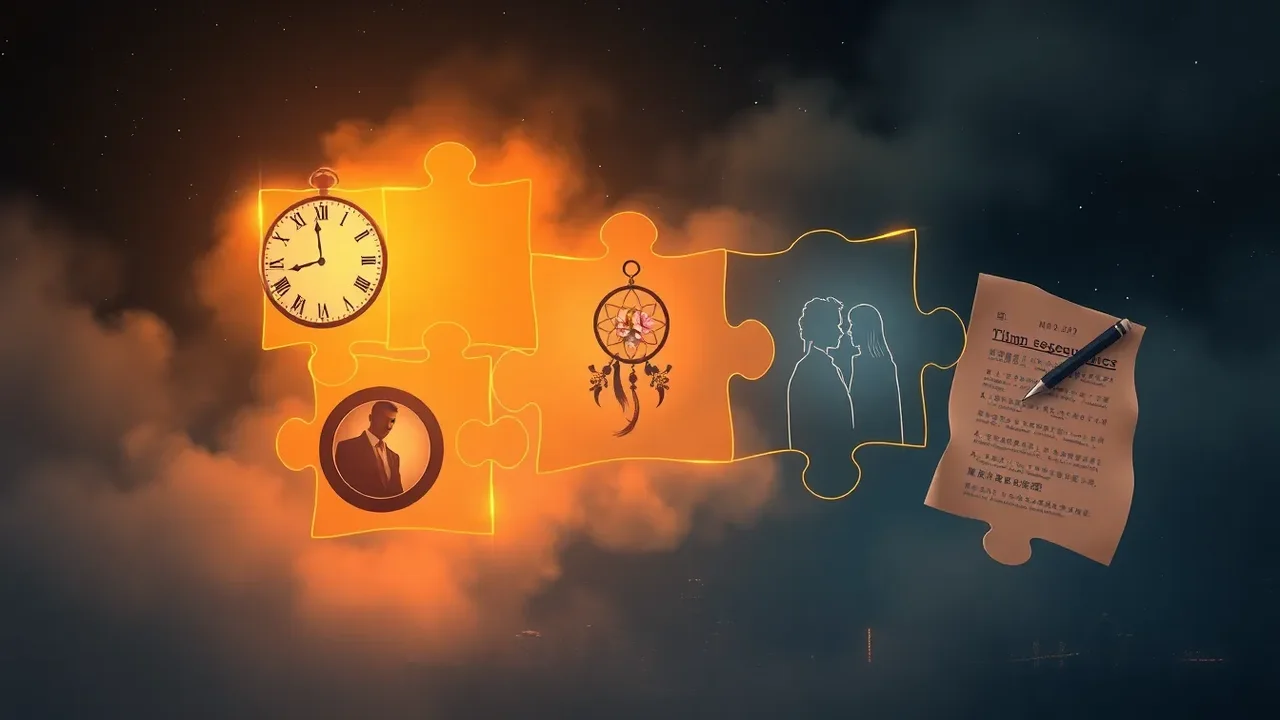
Understanding the Time Loop Mechanism

The time loop theory in this hit dorama novel, "Eternal Recurrence", functions as the central narrative engine. The protagonist, a young journalist named Hana, discovers she is trapped in a 48-hour cycle that resets every time she fails to prevent a catastrophic event. Unlike conventional time loops that simply repeat days, the novel's loop is dynamic: each reset alters minor details based on choices made in the previous cycle. This creates a branching web of possibilities, forcing Hana to learn from each iteration. The loop is triggered by a mysterious artifact—a pocket watch that stops at exactly 11:59 PM. When the watch stops, the loop resets, and Hana retains full memory of all prior cycles. Other characters may have partial or no memory, depending on their proximity to the artifact. The theory posits that the loop is not a punishment but a test to reshape fate through accumulated wisdom.
Core Principles of the Loop
- Reset Condition: The loop resets when the protagonist fails to stop a specific disaster or when 48 hours elapse without achieving a fixed goal.
- Memory Persistence: Only Hana retains complete memories of previous loops; side characters either forget entirely or experience deja vu.
- Ripple Effects: Actions in one loop produce subtle changes in the next—a conversation moved to a different location, a letter found earlier, or a character's mood shifted.
- Nexus Events: Certain pivotal events (like a train crash or a murder) are fixed anchors; they always occur unless Hana intervenes in very specific ways.
- Cost of Intervention: Major changes to the timeline drain Hana's energy, causing physical exhaustion that persists across loops.
Character Perspectives and Memory Retention
The novel employs a detailed system to track who remembers what. The following table outlines the memory levels of key characters after several loops:
| Character | Role | Memory Level | Influence on Loop |
|---|---|---|---|
| Hana (Protagonist) | Journalist | Full retention | Can plan strategic actions |
| Kaito (Police Officer) | Love interest | Vague deja vu after 5 loops | Begins to sense patterns, aids Hana |
| Rin (Best Friend) | Cafe owner | No memory | Acts as moral anchor, pure reactions |
| Professor Mori | Physicist | Partial fragments after 10 loops | Helps Hana theorize the loop mechanics |
| Antagonist (Mr. Kuro) | Corporate head | No memory but strategic intuition | Unknowingly adapts to Hana's interference |
This table illustrates how the loop affects different individuals, creating a layered puzzle for Hana to solve. She must leverage Kaito's growing awareness while protecting Rin's innocence.
Practical Implications and Storytelling Techniques
The time loop theory in "Eternal Recurrence" is not merely a plot device; it serves as a vehicle for character development and thematic exploration. Hana's repeated attempts teach her empathy, patience, and the value of small gestures. For readers, the loop creates tension because each cycle brings new information while erasing previous social progress. The novel uses a technique called "layered revelation": Hana uncovers clues in a non-linear order, forcing her to synthesize knowledge from multiple timelines. For example, in Loop 1, she learns a suspect's alibi; in Loop 3, she discovers the alibi is false; in Loop 7, she finds out the reason for the false alibi. This mirrors real-life learning through trial and error.
Key Plot Points Enhanced by the Loop
- First Loop (Ignorance): Hana experiences the disaster without understanding; she dies or witnesses tragedy.
- Second Loop (Initial Investigation): She tries to warn people but is dismissed as crazy.
- Fourth Loop (Building Trust): Hana uses repeated interactions to earn Kaito's trust, altering his future actions.
- Eighth Loop (Sacrifice): Hana discovers that preventing the main disaster requires sacrificing her own safety, leading to a moral dilemma.
- Twelfth Loop (Mastery): All clues converge; Hana executes a perfect plan but faces an unforeseen consequence—the loop paradox.
Rules and Limitations of the Loop
To maintain narrative consistency, the novel establishes hard rules for the time loop. These are presented in the following table:
| Rule | Description | Example in Story |
|---|---|---|
| Fixed Duration | Loop always lasts exactly 48 hours, starting at midnight. | Hana cannot extend beyond 48 hours; she must act within that window. |
| No External Save Points | Only Hana's consciousness resets; physical objects return to original state. | A key she hid in Loop 3 is gone in Loop 4 because she hadn't hidden it yet. |
| Information Decay | If Hana dies during a loop, her memory of the final hours may be fragmented. | After a fatal car crash in Loop 6, she only remembers seeing headlights. |
| Parallel Awareness Cap | At most three characters can share loop awareness at one time. | When Kaito and Professor Mori both remember, a fourth cannot join. |
| Loop Count Ceiling | The loop breaks after 13 cycles; Hana must succeed by then or face permanent death. | In the novel's climax, Hana has only one final attempt. |
These rules prevent deus ex machina solutions and force Hana to use creativity and small iterative changes. For instance, she cannot simply re-hide a weapon; she must learn its significance to the overall plot.
Detailed Explanations and Examples from the Novel
The time loop theory is explored through Hana's journal, which she updates across loops. In one powerful sequence, she writes: "I have lived the same conversations twelve times. Each repetition peels away a layer of deception." The novel includes a subplot where Hana meets a street musician who plays a song that changes slightly each loop—a subtle clue that the loop affects even ambient details. The theory also introduces the concept of "loop gravity": events that attract the most protagonistic attention become more likely to change, while minor background events remain static. This allows the author to maintain a consistent setting while evolving the core mystery.
Practical Information for Readers
For those analyzing the novel's time loop theory, key takeaways include: 1) The loop is a narrative tool that emphasizes character growth over plot convenience. 2) Each reset provides an opportunity to explore different facets of Hana's personality (fear, desperation, hope, determination). 3) The loop's limitations—like the 13-cycle cap—create a ticking clock that raises stakes. 4) Readers can track Hana's progress through the author's use of a chapter numbering system that indicates loop count (e.g., Chapter 2.1, 2.2, etc.). 5) The time loop theory also critiques deterministic storytelling; Hana's choices have meaning because they accumulate.
Examples of Loop-Induced Character Development
- Kaito: In early loops, he distrusts Hana. By Loop 5, he starts to have spontaneous memories. In Loop 10, he actively seeks her out before the usual trigger event. This shows how even partial memory can shift relationships.
- Rin: Because Rin never remembers, she provides a constant emotional baseline. Hana learns that some bonds are valuable precisely because they are innocent and unaffected by the loop.
- Professor Mori: His partial memories allow him to become Hana's collaborator. His scientific approach contrasts with Hana's intuitive leaps, creating a balanced partnership.
The time loop theory is dramatized in a key scene: Hana attempts to prevent a bombing by calling in a tip. In Loop 4, the call is ignored. In Loop 5, she uses a different voice. In Loop 6, she sends an anonymous letter. The variation shows how small changes in method produce different outcomes, illustrating the iterative nature of the loop.
Advanced Theoretical Concepts in the Novel
Beyond the basic mechanics, "Eternal Recurrence" introduces "echo loops"—faint impressions of previous cycles that manifest as collective deja vu among the city's residents. Hana discovers that if she writes a note and leaves it in a specific location, the note fades to illegibility by the next loop, but the words remain in the subconscious of those who read it. This echoes the idea that the loop is not just a personal prison but a community memory disturbance. The novel also explores the ethical dimension: is it right for Hana to manipulate people who cannot consent because they will not remember? This moral ambiguity adds depth to the theory.
Loop Mechanics in Action: A Step-by-Step Analysis
Consider the sequence of events in Loops 8-12 as a case study. Hana learns that the disaster is caused by a flawed safety system at a chemical plant. In each loop, she tries different approaches: (a) reporting to authorities — leads to cover-up; (b) sabotaging the system — causes earlier explosion; (c) convincing the plant manager — he needs proof. Finally, in Loop 11, she uses evidence gathered over multiple loops (a hidden camera in Loop 3, a whistleblower's testimony in Loop 7) to expose a conspiracy. The loop theory allows her to assemble a puzzle that no single timeline could provide. This demonstrates how time loops can serve as a narrative device for incremental revelation.
Practical Summary for Readers
In summary, the time loop theory in "Eternal Recurrence" is a well-constructed system with clear rules, character-specific memory retention, and a built-in countdown. It encourages readers to pay attention to subtle changes in dialogue, setting, and character behavior across loops. The theory also serves as a metaphor for personal growth—each loop represents a chance to refine one's approach to life's challenges. The novel's success lies in balancing the loop's mechanical consistency with emotional payoff, making it a standout example of time loop storytelling in the dorama novel genre.
FAQ - The Time Loop Theory in This Hit Dorama Novel
What is the time loop theory in 'Eternal Recurrence'?
The time loop theory is the narrative device where the protagonist Hana repeats a 48-hour cycle each time she fails to prevent a disaster. She retains her memories, while others do not, allowing her to learn and make incremental changes to alter the outcome. The loop is governed by rules such as a 13-cycle limit and fixed anchor events.
Does Hana ever lose her memories across loops?
No, Hana retains all memories from every loop. However, if she dies before the loop ends, her memory of the final moments may be fragmented. This is a key mechanic that forces her to plan carefully to avoid fatal mistakes.
How do side characters like Kaito and Rin experience the loop?
Kaito starts with no memory but gradually develops vague deja vu after several loops, eventually becoming able to sense patterns. Rin never remembers anything, providing a consistent emotional anchor. Professor Mori gains partial memory fragments that help Hana theorize the loop's mechanics.
What are the rules of the time loop in the novel?
Key rules include: loop lasts exactly 48 hours, Hana's consciousness resets but objects do not, only three characters can share loop awareness at once, and the loop breaks after 13 cycles. Major changes drain Hana's energy, and certain events (nexus events) are fixed unless specific conditions are met.
Is the time loop theory explained scientifically in the novel?
The novel offers a pseudo-scientific explanation through the character of Professor Mori, who hypothesizes that the pocket watch artifact creates a localized temporal distortion. However, the theory is more philosophical, emphasizing the loop as a test for personal growth and moral choices rather than hard science.
The time loop theory in the hit dorama novel 'Eternal Recurrence' centers on protagonist Hana, who relives a 48-hour cycle to prevent a disaster, retaining memories across resets. With hard rules, partial awareness in side characters, and a 13-loop limit, the narrative uses incremental learning to explore fate, morality, and personal growth.
In conclusion, the time loop theory in this hit dorama novel is a meticulously crafted narrative framework that blends suspense, character development, and ethical dilemmas. By establishing clear rules and limitations, the author transforms a simple premise into a rich exploration of human perseverance and the power of small changes. Hana's journey through thirteen loops not only saves lives but also redefines her understanding of destiny and free will, making 'Eternal Recurrence' a compelling read for fans of time loop storytelling.